
Aðalhús
- May 26
- 3 min read
Circularity on a smaller scale
The summer house discussed here was originally built in 1962. It was built from scrap materials, like many other houses in the same area. Instead of demolishing it and starting from scratch, it was decided to work with what was already there, by expanding the house, renovating it and adding new units. The project developed so that the main house was renovated and expanded, a guest house was built next door and later a sauna on the property. From the beginning, the goal was to use existing materials as much as possible.

Materials from here and there
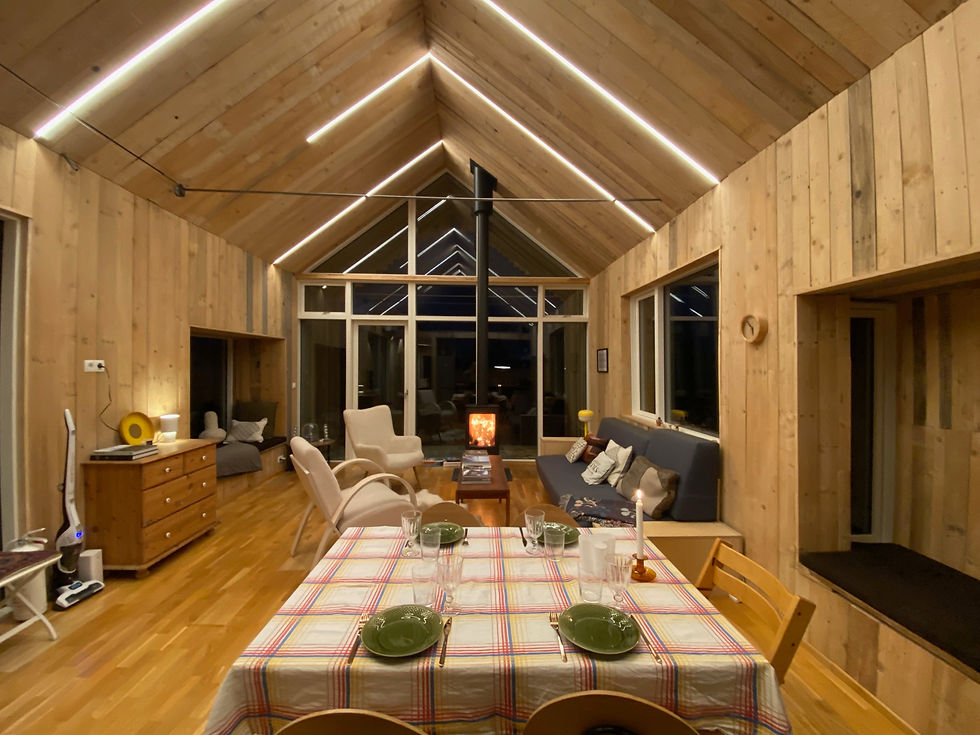
A large part of the building material came from leftovers that would otherwise have been thrown away. Einar approached hardware stores to get waste materials and materials were also obtained from individuals, for example from the demolition of older structures. The guesthouse is almost entirely built from reused materials. The interior cladding in the guesthouse comes from another project where there had been a material surplus which was on its way to disposal. In the main house, among other things, pine wood that had been used to transport large pipes were used. They had not been used much and were well suited as cladding for walls and ceilings. The flooring in both houses was parquet that had been stored for years along with other reused parquet. The tiles in the bathrooms came from a project that never came to fruition.
Adaptable design
The project was largely shaped by the materials available. The windows and doors used in the project were so-called B-products from stores, which had been ordered in excess of what was needed from another project and the design of the summer house was then adapted to them. This resulted in significant financial savings. The same approach was taken for the cladding. It is assembled from waste wood that has been sawn into pieces and at first glance appears to be arranged randomly, but upon closer inspection there is a lot of repetition that forms a coherent whole.
The wood in the cladding was not specially treated. Instead, it was assumed that the material would age on its own terms. Over time, it will turn gray and become one with the environment, and when necessary, individual parts can be replaced rather than renewing everything at once.
The majority of the construction was done by the designer himself, although assistance was obtained for more specialized tasks such as concrete, electrical and plumbing. The project called for a new approach to work methods and required both endurance and adaptability.

Sauna made from reused dock material
The sauna on the property is also made from reused materials. It used hardwood that had been left over from dock construction. The pieces were stacked without sawing them down and fastened together with steel pins. The shape of the building was shaped by the material itself, and windows were inserted where gaps formed.
Cost and lessons learned
The project shows that significant cost savings are possible with this approach on a smaller scale, possibly up to half of the traditional construction costs. At the same time, important experience and knowledge were gained on how to access materials, design based on them and implement buildings based on these assumptions.
Reuse was a guiding principle from the beginning. Instead of adapting the material to a predetermined design, it was allowed to shape it. The result is a house where the origin of the material is visible and part of the whole. The project thus reflects both the conditions of the site and the method used, to build from what was available.



Comments